Common Seal Specification Mistakes (and How to Avoid Them)

Home | Common Seal Specification Mistakes (and How to Avoid Them)

Most seal failures trace back to a small number of specification errors at the design or sourcing stage. These mistakes are common, correctable, and typically avoidable with better questions asked earlier. This guide covers the mistakes engineers make most often and the steps that prevent them.

Mistake 1: Getting the Sizing Wrong

Sizing errors show up in three forms: wrong cross-section, wrong groove dimensions, and wrong stretch or squeeze.

Common sizing errors:

  • Specifying a stock O-ring size when the gland calls for a slightly different cross-section
  • Overlooking dimensional tolerances on the mating parts, which shifts groove volume
  • Ignoring stretch limits at installation
  • Failing to account for thermal expansion of the mating parts at operating temperature

How to avoid it:

  • Confirm actual groove dimensions against the seal manufacturer's design guide before specifying.
  • Calculate squeeze and stretch based on measured groove volume, not nominal dimensions.
  • For non-standard glands, consider a custom-molded profile designed to the specific geometry.
  • Send a drawing when quoting. Sizing errors are far easier to catch when someone reviews the gland design.
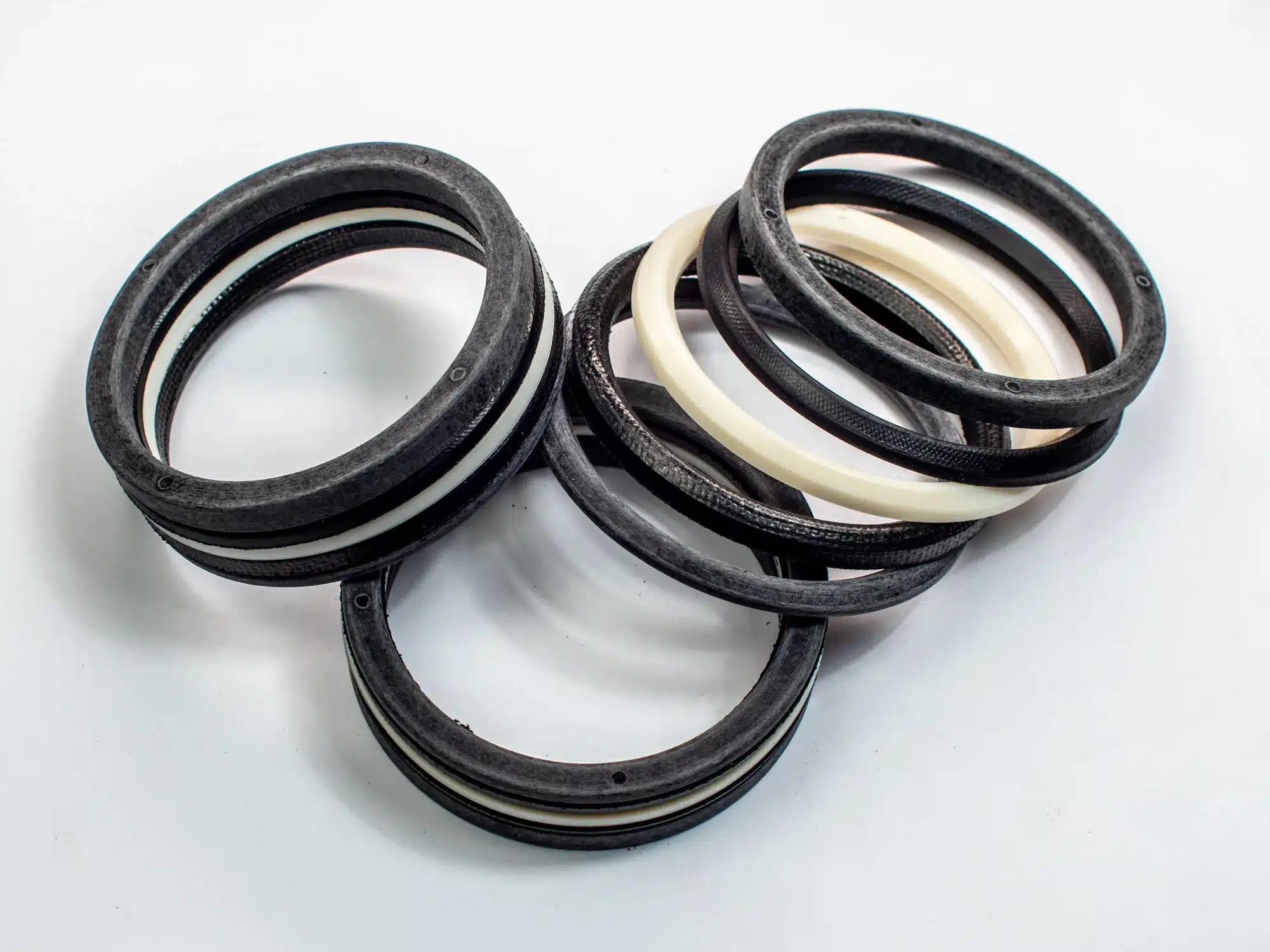
Hydraulic seals

Mistake 2: Material Mismatch With the Operating Environment

Choosing the wrong compound for the service environment causes chemical attack, thermal breakdown, or premature aging. It's the second-most-common cause of premature seal failure after sizing errors.

Common material mismatches:

  • Specifying NBR (nitrile) for service that includes aromatic fuels or ozone exposure
  • Using EPDM in petroleum oil systems. EPDM handles water and brake fluid well but is not oil-resistant.
  • Selecting a standard FKM compound for sour gas service without confirming the formulation is engineered for H2S
  • Assuming silicone will hold up dynamically. Silicone is a strong static seal material but wears quickly in dynamic service.
  • Overlooking additives, plasticizers, or trace contaminants in the service fluid that attack the base compound

How to avoid it:

  • Verify compatibility against manufacturer resistance data for the actual service fluid, not a generic category
  • For any application with chemical or thermal aggression, ask for compound performance testing and traceability documentation
  • When the service fluid changes (customer reformulation, new supplier), re-verify compatibility before continuing production

Mistake 3: Assuming the Operating Environment Instead of Measuring It

Specifications often reflect the environment engineers think exists rather than the one actually there. Real service conditions include short-term excursions, pressure spikes, thermal cycling, and contamination that the datasheet ignores.

Common environment assumptions that cause failures:

  • Using steady-state temperature only, without accounting for excursions
  • Ignoring pressure spikes or rapid decompression events
  • Not accounting for secondary contaminants (dust, wash water, biological load)
  • Assuming clean fluid when field conditions include particulate
  • Missing solar or UV exposure in outdoor equipment

How to avoid it:

  • Document the full operating envelope: continuous range, peaks, cycle rate, contamination profile
  • For applications with rapid pressure changes, specify compounds engineered for rapid gas decompression
  • For outdoor exposure, use compounds with proven UV and ozone resistance
  • Include field failure history when re-specifying. Prior failures reveal environmental factors the original spec missed.

Mistake 4: Overlooking Standards and Certification Requirements

  • Applications that require third-party certification, including food, potable water, electrical, and aerospace, have compliance requirements that override normal material selection. Missing these upfront means requalifying the part later.

    Common certification oversights:

    • Specifying a standard compound for food-contact service without confirming NSF 51 or NSF 61 certification
    • Missing UL requirements for electrical applications (UL 157, UL 94, UL 50E, UL 508). See our UL Rubber page for the full standards covered.
    • Ignoring aerospace or MIL-SPEC callouts on the drawing
    • Assuming a compound family qualifies for a standard when only specific formulations within the family are certified

    How to avoid it:

    • List every applicable standard and certification at the top of the specification, not buried in a note
    • Request certification documentation from the supplier before ordering production quantities
    • Confirm that any secondary treatment (coating, lubrication, color) does not invalidate the certification

Mistake 5: Ignoring Assembly and Installation Stress

A seal spec is only complete when it accounts for how the part gets installed. Assembly damage causes failures that look like material issues but are actually installation issues.

Common assembly-stress oversights:

  • No installation lead-in chamfers on shafts or bores, causing O-rings to shave during installation
  • Sharp edges on mating parts that cut sealing surfaces
  • Excessive stretch during installation onto shafts
  • Missing lubrication at assembly, causing seals to twist or roll
  • Tolerance stack-up that leaves too little clearance for the seal to compress correctly

How to avoid it:

  • Include install chamfers and edge break requirements on the mating parts, not just the seal drawing
  • Specify pre-lubrication or PTFE coating when installation friction is a concern
  • Include an installation procedure with the spec. That catches lead-in and lubrication issues before parts reach the line.
  • For automated assembly, involve a seal specialist early to confirm the geometry feeds reliably through the equipment

Mistake 6: Skipping Prototype Validation

The final and most preventable mistake: moving from spec to production without physical testing. Datasheets are not a substitute for actual application testing.

How to avoid it:

  • Order prototype quantities and validate in the actual assembly under real service conditions
  • Run accelerated life testing where feasible
  • Track early field failures and feed the data back into the specification

Have a Seal Spec You Want a Second Set of Eyes On?

Send us the drawing, the operating envelope, and the service environment. We'll flag potential mismatches and recommend adjustments before production.

Frequently Asked Questions

Material-to-environment mismatch. Engineers select a compound based on category (temperature, media type) without confirming the specific formulation that resists all the trace chemistries in the actual service fluid.

The clearest signal is field failure history. If a specific seal position fails more than others, the spec probably underestimates one operating factor. Documented field failures are a better guide to real service conditions than the original spec assumptions.

Not necessarily. Named compounds carry traceability advantages, but many application-critical requirements are met by equivalent compounds when the supplier provides compound performance testing and traceability documentation.

Before finalizing the specification, not after a failure. A specialist can flag material mismatches, gland design issues, and manufacturing constraints while changes are still cheap.

Compound performance testing, material traceability, and, for regulated applications, copies of the applicable certifications (NSF, UL, ISO, aerospace). See our related guide on selecting seals for harsh environments for the broader framework.
Copyright ©2026 North Coast Seal

Questions?

Curious about availability, pricing, and turnaround?