The Definitive Guide to O-Ring Types and Applications

Home | The Definitive Guide to O-Ring Types and Applications

What Is an O-Ring?

In some applications, sealing performance isn’t the only priority.

Industries involving potable water, food processing, pharmaceuticals, or regulated manufacturing environments often require materials that align with defined safety and certification standards — while still performing under real-world operating stress.

Compliance isn’t just about documentation. It’s about consistency, traceability, and risk mitigation.
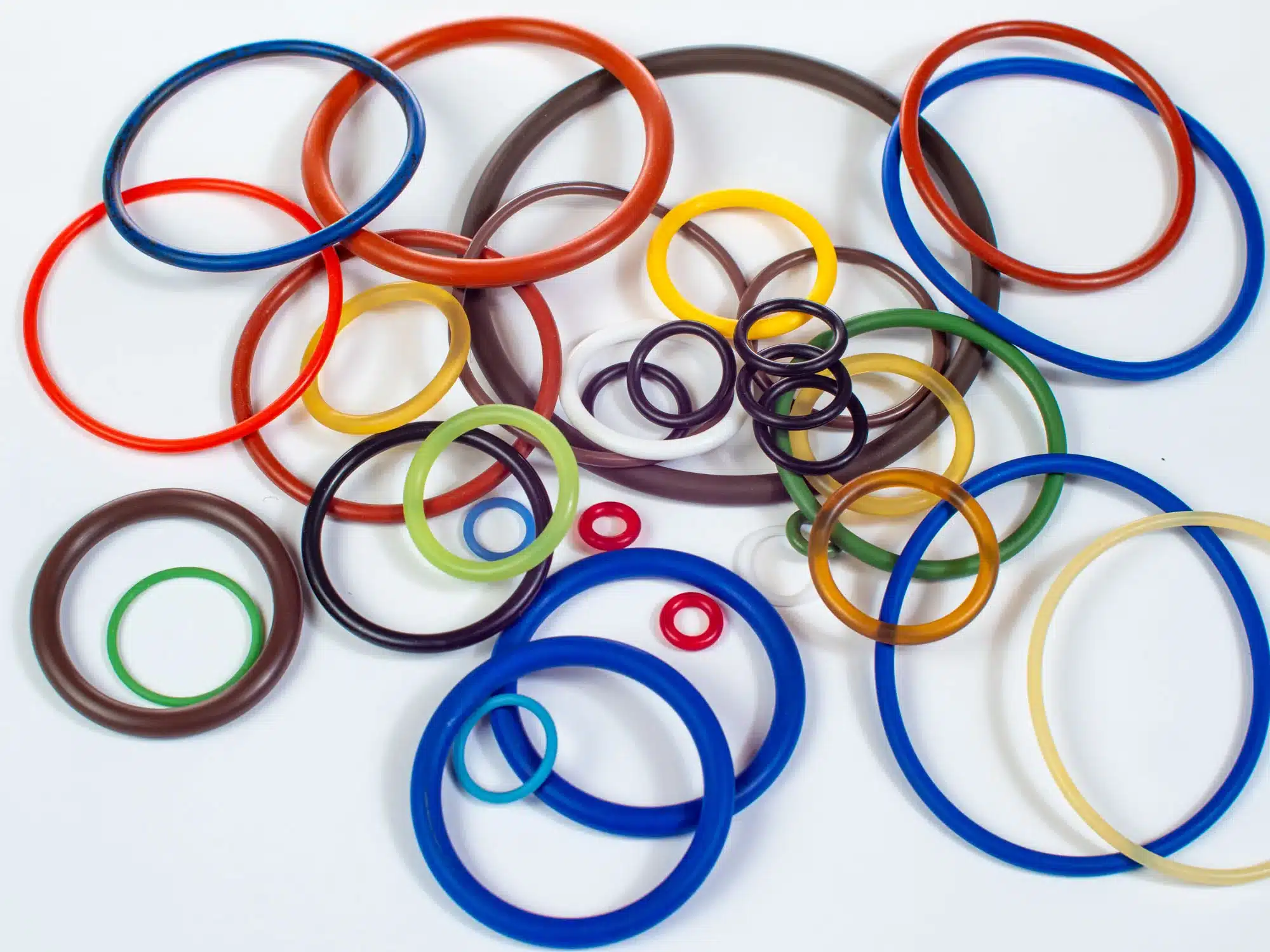
colorful o-rings

A Brief History of the O-Ring

Although sealing concepts have existed for centuries, the modern O-ring is commonly associated with Niels Christensen, who received a patent for the design in 1937.

What began as a simple sealing device has evolved into a critical component used in industries including:

  • Aerospace
  • Automotive
  • Fluid power
  • Food and beverage processing
  • Semiconductor manufacturing
  • Energy, oil, and gas
  • Water treatment

Today, O-rings are manufactured from dozens of elastomer and engineered materials designed to withstand extreme temperatures, pressures, chemicals, and environmental conditions.

How O-Rings Work

O-rings function by creating a mechanical seal between two surfaces.

When installed in a properly designed groove and compressed during assembly, the O-ring fills small gaps between mating components. This compression creates a sealing force that prevents leakage.

As system pressure increases, the pressure itself helps force the O-ring against the sealing surfaces, improving sealing effectiveness.

For this reason, proper material selection, groove design, and sizing are critical to long-term performance.

Static vs. Dynamic O-Ring Applications

One of the most important considerations when selecting an O-ring is determining whether the application is static or dynamic.

Static Sealing Applications

Static seals are used when there is little or no movement between sealing surfaces.

Common examples include:

  • Pipe flanges
  • Tank covers
  • Valve bodies
  • Electrical enclosures
  • Filter housings

Static applications generally place less stress on the O-ring and often allow for a wider range of material options.

Dynamic Sealing Applications

Dynamic seals operate where movement occurs between components.

Examples include:

  • Hydraulic cylinders
  • Pneumatic cylinders
  • Pumps
  • Rotary shafts
  • Actuators

Because friction, wear, and pressure cycling occur during operation, dynamic applications often require more careful material selection and design considerations.

Why Application Type Matters

The same O-ring material may perform exceptionally well in a static application but fail prematurely in a dynamic environment.

Factors such as abrasion resistance, compression set resistance, lubrication requirements, and pressure cycling should all be considered during the selection process.

Common Types of O-Rings

Not all O-rings are the same. Different materials, sizes, and performance characteristics make certain O-rings better suited for specific applications.

Standard O-Rings

Standard O-rings are manufactured to common AS568 and metric sizing standards and are widely used throughout industrial equipment.

Benefits include:

  • Broad availability
  • Cost-effectiveness
  • Easy replacement
  • Compatibility with many applications
  • Metric O-Rings

Metric O-rings follow international sizing standards and are commonly found in imported equipment and globally manufactured systems.

Custom O-Rings

Custom O-rings are designed for applications requiring:

  • Non-standard dimensions
  • Specialized materials
  • Unique performance requirements
  • Regulatory compliance

Custom solutions can help address sealing challenges where standard products may not provide adequate performance.

Food-Grade O-Rings

Food-grade O-rings are commonly manufactured from materials that meet FDA, NSF, or other food-contact requirements.

Applications include:

  • Food processing equipment
  • Beverage production systems
  • Pharmaceutical manufacturing
  • Sanitary processing environments
  • High-Temperature O-Rings

High-temperature O-rings are designed to withstand elevated operating temperatures without hardening, cracking, or losing sealing performance.

Chemical-Resistant O-Rings

Chemical-resistant materials are selected for applications involving:

  • Acids
  • Solvents
  • Fuels
  • Oils
  • Aggressive process chemicals
  • UL-Recognized O-Rings

Certain applications require materials that align with UL standards for electrical and industrial equipment.

UL-recognized materials are often used in:

  • Electrical enclosures
  • Control panels
  • Industrial electronics
  • Safety-critical equipment
  • O-Ring Materials Explained

Selecting the proper material is often the most important factor in O-ring performance.

Nitrile (Buna-N)

Nitrile is one of the most commonly used O-ring materials due to its balance of performance and affordability.

Best suited for:

  • Petroleum oils
  • Hydraulic fluids
  • General industrial equipment
  • EPDM

EPDM provides excellent resistance to:

  • Water
  • Steam
  • Weathering
  • UV exposure
Common applications include water treatment, outdoor equipment, and food processing systems.

Silicone

Silicone offers excellent flexibility and temperature resistance.

Common applications include:

  • Food processing
  • Medical equipment
  • Electronics
  • Extreme temperature environments
  • FKM (Viton®)

FKM materials provide excellent resistance to:

  • Fuels
  • Oils
  • Chemicals
  • Elevated temperatures
These materials are widely used in aerospace, automotive, and industrial processing environments.

PTFE

PTFE provides exceptional chemical resistance and low friction characteristics.

Applications often include:

  • Chemical processing
  • Semiconductor manufacturing
  • Aggressive fluid handling
  • FFKM

Benefits include:

  • Exceptional chemical compatibility
  • High-temperature resistance
  • Long service life in demanding environments
  • How to Choose the Right O-Ring
Perfluoroelastomers (FFKM) represent one of the highest-performing sealing materials available.

Several factors should be evaluated before selecting an O-ring.

O-Ring Operating Temperature

Every elastomer has a temperature range within which it performs reliably.

Operating outside that range may result in:

  • Hardening
  • Cracking
  • Loss of elasticity
  • Premature failure
  • Chemical Exposure

The chemicals present in the application can dramatically affect O-ring performance.

Even highly durable materials may degrade when exposed to incompatible fluids.

Black O-rings in NCS warehouse

O-Ring Pressure Requirements

Higher-pressure applications may require:

Harder compounds

Backup rings

Specialized groove designs

Movement and Wear

Dynamic applications generally require materials with better wear resistance than static applications.

O-Ring Regulatory Requirements

Some applications require compliance with standards such as:

NSF 51

NSF 61

FDA

UL

ASTM specifications

Selecting materials that meet application requirements can simplify compliance and documentation processes.

Common O-Ring Failure Modes

Understanding why O-rings fail can help prevent costly downtime and equipment damage.

Compression Set

Compression set occurs when an O-ring permanently loses its ability to rebound after compression.

Swelling

Chemical incompatibility can cause excessive material expansion and loss of sealing effectiveness.

Cracking

Temperature extremes, ozone exposure, or aging can lead to surface cracking.

Extrusion

High pressure can force portions of the O-ring into clearance gaps, damaging the seal.

Abrasion

Repeated movement may wear away sealing surfaces over time.

Chemical Attack

Exposure to incompatible chemicals may cause softening, hardening, swelling, or material breakdown.

O-Ring Sizing and Cross-Section Basics

Proper sizing is essential for seal performance.

Three key dimensions determine O-ring size:

1. Inside Diameter (ID)

The measurement across the center opening.

2. Outside Diameter (OD)

The overall diameter measured across the outer edge.

3. Cross-Section (CS)

The thickness of the O-ring body.

Even small dimensional variations can affect sealing performance, making proper specification important for both static and dynamic applications.


Industries That Depend on O-Rings

O-rings are used throughout modern manufacturing and industrial systems.

Aerospace

Sealing hydraulic systems, fuel systems, and critical flight components.
Learn more

Automotive

Used in engines, fuel systems, brakes, transmissions, and emissions systems.
learn more

Food & Beverage

Supporting sanitary processing equipment and fluid handling systems.
learn more

Fluid Power

Providing reliable sealing in hydraulic and pneumatic equipment.
learn more

Semiconductor

Protecting sensitive manufacturing environments from contamination.
Learn more

Energy, Oil & Gas

Managing pressure and chemical exposure in demanding operating environments.
learn more

Frequently Asked Questions About O-Rings

Nitrile (Buna-N) is among the most commonly used materials due to its affordability and compatibility with many industrial fluids.

EPDM performs well with water, steam, and weather exposure, while FKM excels in oil, fuel, and chemical applications.

Service life depends on operating conditions, material selection, pressure, temperature, and chemical exposure.

While reuse may be possible in some situations, replacing O-rings during maintenance is generally recommended to ensure sealing reliability.

Common causes include improper sizing, chemical incompatibility, excessive temperature exposure, wear, and installation damage.

O-ring sizing is determined by inside diameter and cross-section dimensions. Proper groove design and application requirements should also be considered.

Need Help Finding the Right O-Ring?

Selecting an O-ring involves more than matching dimensions. Material compatibility, operating temperatures, chemical exposure, pressure requirements, and regulatory standards all influence long-term sealing performance.

Whether you need standard O-rings, custom molded components, food-grade materials, or high-performance sealing solutions, North Coast Seal can help identify options that align with your application requirements.


Copyright ©2026 North Coast Seal

Questions?

Curious about availability, pricing, and turnaround?